Saturday, October 29, 2016

Wednesday, October 26, 2016
"Like a complete unknown ..."
I suppose I'm going to have to weigh in on this whole Bob Dylan-Nobel Prize thing, but since Dylan himself hasn't acknowledged it yet, I haven't felt too much pressure. According to Adam Kirsch, our latest laureate isn't even returning the Swedish Academy's phone calls, and now the Lords of Literature are getting all huffy, accusing their newest poster boy of being "impolite and arrogant."
They're surprised? The guy has made a career of being impolite and arrogant.
The truth is, I'm neither outraged by the prize, nor am I raising huzzahs, as some have. I'm just not that into Dylan, and the Nobel is not a ticket to immortality. Every year when the prize is announced, we recall the greats who were never named -- Proust, Tolstoy, Conrad, Joyce, Nabokov, Auden -- and we overlook, yet again, the many mediocrities who were. Every Nobel, every Pulitzer, every Oscar, every Grammy is a reminder, as if we needed reminding, that life is unfair.
And then there's the question, is what Dylan does literature? I'd say yeah, sure, why not?, but that admission doesn't make me prouder to be an American living at this particular time.
In the New York Review of Books, Luc Sante argues that while Dylan's lyrics, on their own, might not scan as well as those of Cole Porter or Smokey Robinson, he added a new dimension to song: "As great a Porter and Robinson were as songwriters, they were working in -- and profiting from -- the air of frivolity that attended lyric-writing by the mid-twentieth century, an era that prized verbal dexterity and rapid evaporation. Dylan, through his ambiguity, his ability to throw down puzzles that continue to echo and to generate interpretations, almost singe-handedly created a climate in which lyrics were taken seriously."
In other words, Dylan is more pretentious. What, one may ask, is un-literary about lightness and frivolity? And I hardly think Porter's lyrics have evaporated.
But Dylan was not awarded the Nobel Prize for his lyrics. He was given the award for his songs: the combination of lyrics and music. Anyone who recalls "Like a Rolling Stone" or "When I Paint My Masterpiece" doesn't recite the words. They sing them to themselves, and it is this mutual dependence of words and music that led Alex Ross to compare Dylan to Wagner.
I don't think the comparison quite holds, since Wagner is regarded primarily as a composer. The music, without the words, is still ravishing. Gershwin's melodies, too, stand on their own and have become standards of the instrumental jazz repertoire. Dylan's have not.
Give him his due, though: There may be better lyricists, better guitar players, better tunesmiths -- heaven knows there are better singers -- but few others have combined their talents into something so memorable. He is one of the few cases where the overused word "synergy" is appropriate.
They're surprised? The guy has made a career of being impolite and arrogant.
The truth is, I'm neither outraged by the prize, nor am I raising huzzahs, as some have. I'm just not that into Dylan, and the Nobel is not a ticket to immortality. Every year when the prize is announced, we recall the greats who were never named -- Proust, Tolstoy, Conrad, Joyce, Nabokov, Auden -- and we overlook, yet again, the many mediocrities who were. Every Nobel, every Pulitzer, every Oscar, every Grammy is a reminder, as if we needed reminding, that life is unfair.
And then there's the question, is what Dylan does literature? I'd say yeah, sure, why not?, but that admission doesn't make me prouder to be an American living at this particular time.
In the New York Review of Books, Luc Sante argues that while Dylan's lyrics, on their own, might not scan as well as those of Cole Porter or Smokey Robinson, he added a new dimension to song: "As great a Porter and Robinson were as songwriters, they were working in -- and profiting from -- the air of frivolity that attended lyric-writing by the mid-twentieth century, an era that prized verbal dexterity and rapid evaporation. Dylan, through his ambiguity, his ability to throw down puzzles that continue to echo and to generate interpretations, almost singe-handedly created a climate in which lyrics were taken seriously."
In other words, Dylan is more pretentious. What, one may ask, is un-literary about lightness and frivolity? And I hardly think Porter's lyrics have evaporated.
But Dylan was not awarded the Nobel Prize for his lyrics. He was given the award for his songs: the combination of lyrics and music. Anyone who recalls "Like a Rolling Stone" or "When I Paint My Masterpiece" doesn't recite the words. They sing them to themselves, and it is this mutual dependence of words and music that led Alex Ross to compare Dylan to Wagner.
I don't think the comparison quite holds, since Wagner is regarded primarily as a composer. The music, without the words, is still ravishing. Gershwin's melodies, too, stand on their own and have become standards of the instrumental jazz repertoire. Dylan's have not.
Give him his due, though: There may be better lyricists, better guitar players, better tunesmiths -- heaven knows there are better singers -- but few others have combined their talents into something so memorable. He is one of the few cases where the overused word "synergy" is appropriate.
Friday, October 21, 2016
The holes are very small
 |
Conductor Matthew Glandorf gestures for a soloist to take a bow
after The Choral Arts Society's performance of J.S. Bach's
Cantata BWV 80, Ein feste Burg ist unser Gott.
|
I didn't need an excuse to blow off
Wednesday night's debate between the presidential candidates, but if I had, I
couldn't have asked for a better one than the hourlong "Bach at 7"
concert by Choral Arts Philadelphia. This season, the choir is working though
the cycle of 18 of J.S. Bach's cantatas from 1734-35. Wednesday, it presented
BWV 80, the familiar Ein feste
Burg isst under Gott, and BWV
96, Herr Christ, der einige
Gottesohn, which I had not
known, despite my great affection for Bach's cantatas. Of late, they have
absorbed me more than any other aspect of his work, but there are 260 of the
things. There are only so many hours in a life.
Herr Christ charmed me with its prominent part for
sopranino recorder, played in this performance by Rainer Beckmann, who must be
at least 6-foot-2. (It's always the biggest guys who play the tiniest
instruments. In every bluegrass band I've ever seen, the mandolin player is a
giant.) The sopranino is the dog-whistle of the recorder family. Its lowest
pitch is fˊˊ, and the
holes are quite close together. Modern instruments, like my little plastic job,
are tuned at A=440, but Choral Arts uses the Baroque tuning of A=415. (The
string players also use old-style, convex bows, which produce a softer sound
than modern, concave bows.) Because of the lower tuning, Rainer explained, the
finger holes are very small (though he didn't say why). Then he took his
instrument out of its case and showed it to me: The holes were like pinpricks.
One mystery of the cantata concerned the symbolism of the recorder
part. In Bach's religious music the instrumentation always carries
extra-musical connotations, Matthew Glandorf, the Choral Arts conductor, told
me, but he has been unable to turn up any information on just what the recorder
is supposed to stand for in this work.
"The Holy Spirit," I offered. "Flutes are always
the Holy Spirit."
Unfortunately, the Paraclete is not mentioned anywhere in the
libretto.
I also asked if there might have been practical reason for the
scoring: The sopranino's piercing sound should guarantee that it can be heard over
the chorus and the orchestra -- although in the cavernous nave of St. Clement's
Church, that was not always the case. No, Matthew replied, mere practicality
was not an issue for Bach. There is always a spiritual justification for the
choice of instruments. If anyone has any ideas, now's your chance to show off.
Rainer also said Wednesday night was his first professional gig as
a sopranino player. In that, I have him beat by 20 years. I played the
instrument back in the late 80s in a production of Jean-Claude Van Italie's Mystery Play. It drove the other actors crazy.
Monday, September 19, 2016
The Summer of Lovecraft
 |
| Cthulu |
Autumn begins Thursday, and as the weather gets cooler, I will
have the energy to return to more serious, or at least more difficult, reading. In
the hottest part of the summer, however, I entertained myself with a few
potboilers and, in a project that started small but expanded as the time went
on, the so-called horror fiction of H.P Lovecraft. I say “so-called” not because
the tales were bad ― most of were quite enjoyable ― but because I didn’t find
much horror in them, despite the use of the word the titles of “The Dunwich
Horror” and “The Horror at Red Hook.”
In his most mature fiction, Lovecraft is obsessed by the
idea that human beings are only the latest, and not even the most important,
civilizing force in the planet. Both “In
the Mountains of Madness” and “The Shadow Out of Time” present the ruins of
long-dead cultures that rose and fell millions of years before the extinction
of the dinosaurs. His most famous creation, the monster Chtulu, lives in
another dimension but can break through at any time if someone utters the right
incantation.
The sickly scion of a New England family, Lovecraft was preoccupied
with inbreeding among the white population ― “The Dunwich Horror” distinguishes
between the decayed and undecayed branches of the Whateley Family ― and, on the
flip side, with the rise of what used to be called the “colored races.” His work
is sometimes marred by crude and cliched bigotry, as in the description, in “Herbert
West ― Reanimator,” of an African American boxer who has been killed in the ring:
“He was a loathsome, gorilla-like thing, with abnormally long arms which I could
not help calling fore legs, and a face that conjured up thoughts of unspeakable
Congo secrets and tom-tom poundings under an eerie moon.”
Where a more sympathetic writer might see a beautiful, well-muscled
athlete struck down too soon, Lovecraft resorts to jungle metaphors.
 |
| Spawn of Chtulu |
My two favorite stories are among the least known, and the
shortest. “In The Walls of Venus,” an effort at straightforward science fiction
that, unaccountably, didn’t make it into the Library of America’s handy
Lovecraft edition. It’s a well-told tale that builds gradually and inevitably,
without sensationalism, and by the end grows into a parable on the evils of
colonialism ― surprisingly, given the author’s racial attitudes.
The other story that stood out for me, “The
Color Out of Space,” was Lovecraft’s own favorite. Here, he imagines what the astronomer
Neil De Grasse Tyson has described as “different ways of being alive”: the
alien force that destroys a New England family is not humanoid, or animal, or
even material. It is, rather, “a shapeless stream of unplaceable color.”
But as I’ve said, while Lovecraft’s alternative realities can
be absorbing and even exciting, I find little horror in them ― not because of
any lack of skill, but simply because the horror that monsters may inflict on
human beings is nothing compared to the horrors we inflict on each other.
Poe, Lovecraft’s hero, understood this.
Friday, August 26, 2016
Florence Foster Jenkins and Charles Ives

In an earlier post, I referred to Florence Foster Jenkins, portrayed by Meryl Streep in the eponymous film, as a horror. Now, however, the blog Voice Science Works has defended her, or at least her right to sing, because of her enthusiasm and her love of music. "Do we want a world where only a few will sing due to social pressures," the blogger asks, "or one where we all understand that our voices have enormous potential should we seek to find it?"
Personally, I'd go with the social pressures. Ara longa, perhaps, but vita is too damned brevis to put up with incompetence, let alone encourage it. I wouldn't want to waste my time on an execrable singer any more than I would on a juggler who keeps dropping his clubs. Performance might benefit from passion, but it also demands skill.
And yet ... the blogger's defense reminds me of a passage from the Memos of Charles Ives, whose music I have loved since I was a kid and whose ideas have been an ever-present challenge:

Uh oh.
Ives spent much of his creative energy trying to capture the spirit behind the sounds, and, looking at the joy in Streep's face as she butchered "Der Hölle Rache kocht in meinem Herzen," I had to ask myself, have I been missing the music? Is Florence Forster Jenkins the embodiment of the Ivesian ideal of substance over manner?
On this occasion, I'm going to comfort myself by saying no. In the first place, Florence would have hated Charlie's music, as well as his idea that dissonance can lead to higher truth. At the end of the film, we hear her as she heard herself, and in her own mind, she sang like an angel. Earlier, when pianists are auditioning to be her accompanist, we find she can't bear loud, aggressive playing, though her sensitivity was likely a symptom of her lifelong syphilitic condition. Volume and aggressiveness were, of course, staples of Ives's repertoire -- as was humor, and while Jenkins's listeners might feel free to laugh, she took herself seriously.
Ives also would have despised Jenkins's choice of material, which for him typified the easy, spiritually bankrupt world he was rebelling against. For Ives, a man singing a hymn off key is channeling God. A woman singing Mozart, no matter how well, is just singing Mozart.
(Zappa, I think, would have loved her, just as he loved the Shaggs, who he insisted were better than the Beatles. But for Frank, wrong notes weren't about the music of the ages. They were about the subversion of information.)
Over the years, hostile or condescending critics have leveled the same charges against Ives that some reviewers leveled against Jenkins -- amateurism, sloppy technique, and the use of wealth as a buffer against reality -- but right or wrong, Ives was an artist, and a skilled one. His dissonances have purpose, often to wonderful effect, and whatever spiritual vision his scores possess comes though more clearly and forcefully through -- dare I say it? -- a good performance.
Sunday, August 21, 2016
I read a lot of trash in the summer
 Spenser is back, busting the bad guys and overeating, in Slow Burn, Ace Atkins' fifth attempt to extend Robert Parker's deathless franchise. It's his best effort so far, though it can't avoid some of the series' more glaring cliches. In one twist, Spenser, who is gradually showing his age more and more, gets the worst of it in a fistfight with a young thug in the employ of the mob. Atkins plants the seeds for the next book, leaving open the question of a rematch, and just when the mob boss Spenser has ticked off will try to bump him off, but I left wondering why the mob boss would wait until Hawk comes back from France to make his move.
The novel is apparently based on a real-life series of arsons that took place in Boston in the 1980s. In Atkins' telling, the arsonists are a trio of pathetic firefighting wannabes who think causing a crisis will create more support for the fire department. Atkins resorts to Parker's old technique of inserting italic chapters told from the perps' point of view, which gets the miscreants into the story long before our knight errant catches up with them in the last couple chapters. I've never liked this device. The books are supposed to be told from Spenser's point of view, and the shift in perspective has always struck as an authorial intrusion.
Spenser gets into the case, of course, because an angry, loudmouth firefighter doesn't think the higher ups are doing enough to solve it. He asks Spenser to go through the back door, tracking down underworld contacts the arson squad wouldn't know about. Strangely, this approach is nothing but a a red herring: Spenser's initial theory of the case turns out to be wrong, and all he manages to do, at first, is get the mob boss mad at him.
Parker was an efficient writer, not a great one. He didn't have Chandler's style or Hammett's way with a plot. His prose is never memorable. But he was often diverting, and sometimes funny, and he excelled at gunplay (which is why his best books are his westerns). Atkins falls comfortably into the formula. It seems he'll be able to churn out a novel every year until Spenser turns 100.
And he's still taking the easy way out with his character descriptions, making comparisons to minor celebrities of the past. This time out, he tells us one guy resembled Fred Gwynne without the bolts in his neck. There's an esoteric reference for you. If nothing else, Atkins knows his demographic.
Tuesday, August 16, 2016
The inspiring true story of a real-life horror
 |
| Smon Helberg, Meryl Streep and Hugh Grant in Florence Foster Jenkins. Helberg plays Cosme McMoon, Florence's accompanist. Grant is her husband and chief enabler, St. Clair Bayfield. |
I don’t go to the movies much anymore, but on Sunday, with
the heat index at over a hundred degrees, I forewent my usual weekend bike ride
and spent the afternoon in an air-conditioned theater. I saw Florence Foster Jenkins, Stephen Frears’s
comedy-melodrama about the heiress who became the worst singer ever to
perform at Carnegie Hall, with Meryl Streep
in the title role. This isn’t a review.
There are enough of those around. Suffice it to say there weren’t as many
laughs as I’d expected. Simon Helberg, my favorite cast member in The Big Bang Theory, has a few amusing
moments when, as Florence’s hired accompanist, he first gets a load of her vocalizing.
For the rest of the film, however, he has little to do but complain he can’t risk
his reputation by appearing in public with her, then relent every time because
a) the money is too good and b) he grows genuinely fond of the old dame.
My problem, when I left the theater, was that I wasn’t sure
how we are supposed to feel about Florence. Are we supposed to laugh at her? Pity
her? Admire her courage? Is she a trouper or a fool? But now I think there
is no wrong way to respond. Derision, empathy and outrage are all valid reactions,
together or separately, and that very ambiguity may be the point of the
film. Truly, Florence is a horror who makes a mockery of Joseph Campbell’s counsel
to follow your bliss. Most of us overestimate our talents, but few of us
have the money to rent out Carnegie Hall and inflict them on the public. The music
critic who, in the film, writes a devastating review for the Post might be depicted
as a meanie, but he is right to be incensed. The drunken sailors and soldiers in the audience
who think the performance is a joke, a la Jack Benny and his violin, are right
to laugh. And Florence’s supporters in the audience are right to shout them down. They don’t want to see her feelings
hurt.
For all her wealth, Florence had a hard life, having been
infected with syphilis on her wedding night at age 18. I should be
glad she enjoyed her moment in the limelight, but I couldn’t really root for
her. It made no difference to me ― and certainly not to music ― whether she finally
summoned the moxie to walk out onstage.
Monday, August 1, 2016
My own little slice of heaven
 |
| Steve Kramer plays Bach |
Last month, the Times Herald building in Norristown was
closed, to save money, and the staff was scattered to the winds. Now, one day a week, I work from home, two
days a week I work in the Reporter building in Lansdale, and two days a week I
work in the lobby of Norristown’s Centre Theater, where the cellist Steve Kramer teaches on the third floor.
Friday, when Steve was finished with teaching, he brought
his cello down to the lobby to practice. I was the only one of the newspaper staff
who had not yet gone home, and so I was treated to a private performance,
though much of it consisted of warmup scales and arpeggios.
Last year at a benefit concert, also held at the Centre Theater, Steve played one movement of Bach’s
Suite No. 1 in G. Afterward, it seems, I teased him about it, asking him why he
didn’t play the whole thing. I have no recollection of the incident, but Steve
remembered, and he said he I was right. He felt guilty, he said, and to pay me back,
he would play the entire suite right there in the lobby.
Well, you know, I said, my favorite of the Suites is No. 3,
and which point he sat down and played it. He did it in fits and starts, since
he was breaking in a new bow, but he did, eventually, get through the whole
thing, and the extended portions were soul-searing. There is a physicality to
the cello heard in close quarters, a quality not conveyed in recordings, or even
live in a concert hall. One can almost see the instrument vibrate. One can
certainly feel it.
When he was through, he asked me, with a smile, “Have I paid
you back?”
I said we were square.
Fun, if squicky, fact: Bows are made from the hair of horse
tails, but, Steve informed me, only the hair of males is used. Why? Because females,
given the arrangement of their anatomy, stale on their own tails. The hair is impregnated
with urine.
Monday, July 18, 2016
'Two seniors for Zappa'
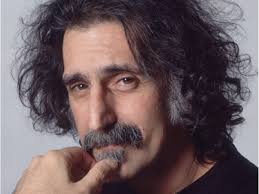 Yesterday afternoon I went to the movies for
the first time in years. The feature that, at long last, lured me out of my apartment
on a weekend was Eat that Question: Frank Zappa in His Own Words, a documentary by Thorsten Schütte. (Leave it to a European
― in this case, a German ― to remind Americans of their own musical heritage. It
took a Dutchman, Frank Scheffer, to film Elliott Carter. )
Yesterday afternoon I went to the movies for
the first time in years. The feature that, at long last, lured me out of my apartment
on a weekend was Eat that Question: Frank Zappa in His Own Words, a documentary by Thorsten Schütte. (Leave it to a European
― in this case, a German ― to remind Americans of their own musical heritage. It
took a Dutchman, Frank Scheffer, to film Elliott Carter. )
The film consists of snippets of TV interviews Zappa gave
over the years, interspersed with performance footage, presented more or less
in chronological order. There is no narration, no subtitles identifying the
interviewers or band members. Viewers are left to navigate the timeline on their
own ― you can estimate when a scene was shot by the personnel, the repertoire,
and the length and color of Frank’s hair ― and it seemed to me that the more
you bring to the film, the more you’ll get out of it. I wondered if anyone who
had never heard of Zappa would have any idea what was going on, but then, anyone
who had never heard of Zappa would never pay the ten-dollar admission price.
Frank says at the top of the film that an interview is an
unnatural situation ― “two steps removed from the Inquisition,” as he puts it ―
and what we get here is very much the public Zappa, who was, in many ways, an
admirable, if paradoxical, figure: One minute, he's inveighing against an educational system that leaves children unprepared to make informed aesthetic judgments. The next, he's singing about anal sex.
(The private Zappa, as we are learning from his daughter
Moon, was not such a bastion of integrity. For one thing, he was an open, serial
adulterer who once gave his wife the clap. In the film, he has a few things to
say about groupies, as well as the clap, but his wife and children are never shown
on camera.)
Over the years, interviewers are constantly struggling to reconcile
Zappa’s outrageousness with what they call his “serious” side, though he
insists he approaches all of his music seriously. A piffle like “Valley Girl”
and long-form compositions with the London Symphony Orchestra, he says, both
present problems in musical form. In an early interview, we see him in his studio,
editing a score with a razor blade, and talking about his ambition to become the
missing link between Varese, Stravinsky and Webern. (Carter attempted much the same
synthesis, with more success.) Years later (as indicated by the hair), he
defines his aesthetic, a favorite word, as “anything, anywhere, anytime, for no
reason at all.” His music, he says, embraces all styles. It contains both complex
and simple rhythms, both dissonances and triads ― an openness that puts him
more in the tradition of Charles Ives, if Ives can be said to belong to a
tradition.
The portrait that finally emerges, almost incidentally, from the nonstop polemics is of a man who loved music for its own sake, and I think Schütte deliberately chose the last shot in the film to reinforce the point. Frank, grizzled, dying of cancer, stands lighted against the darkness and, with concise, weak strokes, conducts an unseen percussion ensemble in “Ionisation” by his beloved Edgard Varese. His eyes are closed. For the only time in the film, perhaps the only time in his life, he looks to be on the verge of tears. He didn’t believe in heaven, and neither do I, but here he is as close to it as he ever expected to come.
Music is the best.
Note: The title of this post was overheard in line at the
box office at the Ritz Theater. The words were spoken by the white-haired woman standing
in front of me. She was in the company of a man who, downstairs at the
concession stand, asked for a pair of headphones so he could hear the movie better. What starker reminder of the passage of time? Zappa has been dead for more
than 20 years, his first album was released 50 years ago this month, and the
youth who rebelled in the ’60s are now collecting Social Security.
Wednesday, June 29, 2016
The Brothers Vonnegut
 One of the few nonfiction books I’ve bothered to read this
year is The Brothers Vonnegut: Science and Fiction in the House of Magic by
Ginger Strand. Not quite a full dual biography,
it's more an examination of the parallel careers of Kurt Vonnegut and his older brother, Bernard, in
the years following WWII, when they both worked at General Electric in
Schenectady, New York -- the House of Magic of the title, Here Kurt wrote
copy for the publicity department
(known pretentiously as the News Division) while Bernard conducted experiments in
cloud seeding. In this period, as in their childhood, Bernard
was the star of the family, a bona fide scientist who followed the path set for
him by his father and uncles. Kurt was the overlooked kid brother, a college dropout, the family
clown who sent story after story to slick magazines and amassed stacks of rejections slips.
One of the few nonfiction books I’ve bothered to read this
year is The Brothers Vonnegut: Science and Fiction in the House of Magic by
Ginger Strand. Not quite a full dual biography,
it's more an examination of the parallel careers of Kurt Vonnegut and his older brother, Bernard, in
the years following WWII, when they both worked at General Electric in
Schenectady, New York -- the House of Magic of the title, Here Kurt wrote
copy for the publicity department
(known pretentiously as the News Division) while Bernard conducted experiments in
cloud seeding. In this period, as in their childhood, Bernard
was the star of the family, a bona fide scientist who followed the path set for
him by his father and uncles. Kurt was the overlooked kid brother, a college dropout, the family
clown who sent story after story to slick magazines and amassed stacks of rejections slips.
The central section of the book flips back and forth between
the brothers’ working lives in the late forties and into the fifties, and Bernard’s
story is far more absorbing. The descriptions of Kurt sitting at his
desk and pounding out prose become repetitive. Bernie, meanwhile, flies off in B-17s and makes rain with silver iodide (maybe). It isn’t until the last fifteen pages
of the book that the roles are reversed, and Kurt becomes the dominant figure.
In Strand’s telling, the years in Schenectady bore most directly on two of Kurt’s novels: Player Piano (which disappointed me) and Cat’s Cradle (which didn't).
The description of Ice-9 in the latter is taken directly from Bernie’s explanation
to his brother about the different ways in which water may crystallize:
He told Kurt to imagine cannonballs stacked on a courthouse
lawn. Just as the balls could be piled up into different shapes, ice crystals
could be stacked into different configurations. In fact, [Percy] Bridgeman had described
a whole series of ice phase variants, ice-1 through ice-6. And who knew—there might
be more to come. (95)
Indeed there was.
Strand’s book also provides a valuable portrait of the GE
corporate culture in those years. The company was then, as now, a central cog
in the military-industrial complex, and it demanded not only the time and
talents of its employees, but their political sympathies as well. And the
sympathies were decidedly right-wing. (It was GE, she reminds us, that launched
the political career of Ronald Reagan.) Kurt loathed the atmosphere, and got
out soon after selling his first couple of stories. Bernard grew disillusioned
over time – rather too much time, it seems – and escaped into academia.
Last aside: In Person of Interest, the sci-fi/action series that concluded its five-year run on CBS this month, the virus that finally destroys the evil computer is called Ice-9. I was tickled to hear that.
Now I’m itching to reread some Vonnegut, when I’m finished (please, God) with Lovecraft.
Subscribe to:
Posts (Atom)